

The name of #Oregon ‘s largest city, Portland, was decided by a literal coin toss.
In 1845, the two men who owned the land claim for the future city couldn’t agree on what to name it. Asa Lovejoy was from Boston, Massachusetts, and Francis Pettygrove was from Portland, Maine—and both wanted to name the new settlement after their respective hometowns.
They decided to settle the dispute with a best-two-out-of-three coin flip using an 1835 copper penny. Pettygrove won the toss.
If the coin had landed differently, the Pacific Northwest’s major cultural hub would be known today as “Boston, Oregon.” The exact coin they used, now known as the “Portland Penny,” is still kept on display at the Oregon Historical Society.
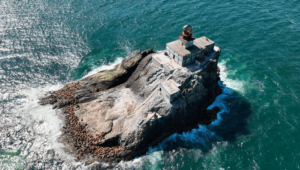
#Oregon’s coast is home to one of the most notoriously dangerous lighthouses in the world: Tillamook Rock Lighthouse, famously known as “Terrible Tilly.”
Sitting on a sheer basalt sea stack just over a mile off the northern Oregon coast, its construction in 1881 was so dangerous that locals refused to work on it, forcing the government to bring in out-of-state laborers who didn’t know the reputation of the rock.
Once operational, the conditions were brutal. Winter storms produced waves so massive they would hurl 135-pound boulders over 100 feet into the air, completely smashing the lighthouse’s glass lantern room. The keepers were frequently cut off from the mainland for weeks at a time.
It was decommissioned in 1957, but its history gets weirder: in the 1980s, the abandoned lighthouse was bought and converted into a privately owned columbarium—a repository for the ashes of the deceased. Today, it still sits isolated offshore, housing dozens of urns and regularly getting battered by the Pacific Ocean.
#Oregon is one of the only states where the entire coastline is legally public property.
Thanks to the landmark 1967 Oregon Beach Bill, private ownership of the beaches is strictly prohibited. From the water up to the vegetation line, all 362 miles of the Oregon coast are free and open to the public—meaning there are absolutely no exclusive, fenced-off private beaches anywhere in the state.
Also located on the coast is a geographic oddity: the world’s shortest river. The D River in Lincoln City flows from Devil’s Lake directly into the Pacific Ocean, measuring a total length of just 120 feet.
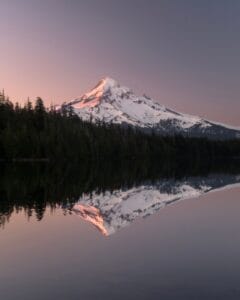
#Oregon holds the records for both the deepest lake in the United States and the smallest park in the world.
Crater Lake in Southern Oregon plunges to a depth of 1,943 feet. It was formed about 7,700 years ago when a massive volcano, Mount Mazama, collapsed after an eruption. Because the lake is fed almost entirely by rain and snow—with no rivers flowing in or out to bring in sediment—it is considered one of the clearest and most pristine bodies of water on Earth.
On the complete opposite end of the size spectrum, Portland is home to Mill Ends Park—which is literally a two-foot-wide circle of dirt in a traffic median. It was officially recognized by the Guinness Book of Records in 1971. Originally intended to be the site for a light pole, weeds grew in the hole instead, prompting a local journalist to plant flowers and name it a park. Today, it usually houses a single small tree and occasionally miniature figurines left by locals.
#Oregon is home to more ghost towns than any other U.S. state. There are over 200 abandoned settlements, mostly left over from the 19th-century gold rush in the eastern, southern, and central parts of the state.
In 1970, the state tried to dispose of a beached whale using a half-ton of dynamite.
A 45-foot, eight-ton sperm whale washed up on the coast near Florence, #Oregon. The highway division was in charge of removing it, and their solution was to blow it up, hoping seagulls would eat the smaller pieces.
Instead, the explosion blasted massive chunks of rotting whale blubber hundreds of feet into the air. It rained down on the spectators who had gathered to watch, and one massive chunk completely crushed a brand-new car parked a quarter-mile away. There is now a commemorative park in Florence playfully named “Exploding Whale Memorial Park.”
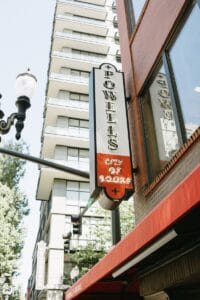
Powell’s City of Books 📖 in Portland is the largest independent bookstore in the entire world, taking up an entire city block and housing over a million books across nine color-coded rooms! #Oregon #PowellsCityofBooks
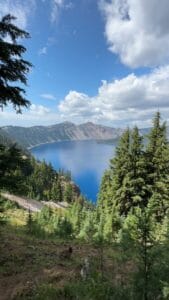
🏔️ Crater Lake is the deepest lake in the U.S. at 1,943 feet deep, formed inside a collapsed volcano without any rivers flowing in or out! 🌋 #oregon
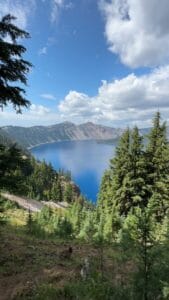
🏖️ Oregon has 362 miles of entirely public coastlines, meaning private ownership of beaches is strictly illegal thanks to the 1967 Beach Bill! 🌊 #oregon
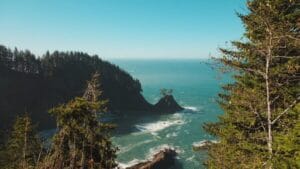
#Oregon is also home to the largest single living organism on Earth. It is a massive root disease fungus (Armillaria ostoyae, or “honey fungus”) that spans thousands of acres underground in the Malheur National Forest in eastern Oregon.


